
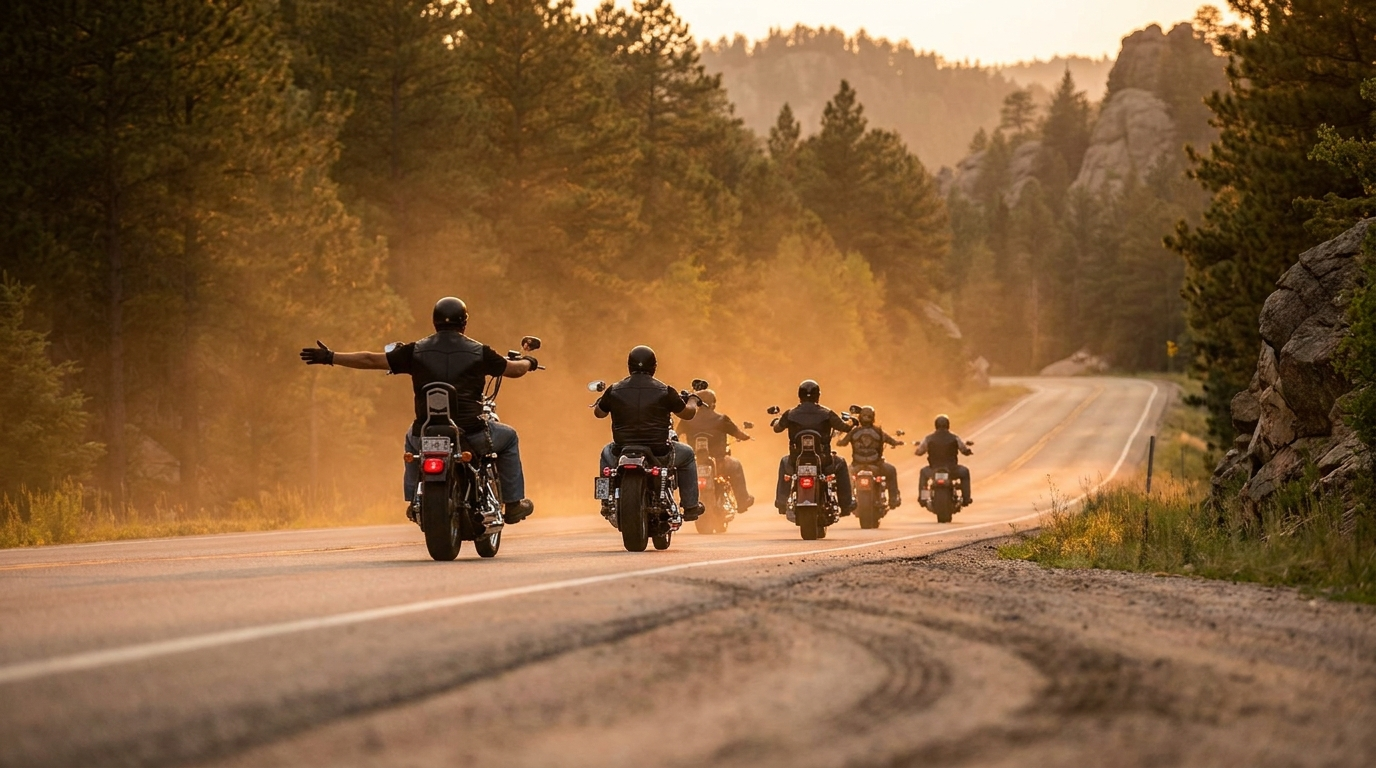
Riding in a group is not just riding near other people. It runs on a shared language: motorcycle hand signals passed from the road captain down the pack, a staggered formation that gives everyone room to react, and a few unwritten rules that keep twenty bikes moving like one. The short version: left arm straight out means left turn, left arm bent up at 90 degrees means right turn, arm angled down with palm facing back means stop, one finger up means single file, and a point at the tank means fuel stop. Learn those five and you can hang with almost any pack. Learn the rest of this guide and you can lead one. With Sturgis only two weeks out and group rides forming up all over the country, now is the time to get fluent.
What Are the Essential Motorcycle Hand Signals?
These signals follow the conventions taught by the Motorcycle Safety Foundation and used by riding clubs across the country. The lead rider throws the signal, and every rider behind repeats it so it travels to the back of the pack. That relay is the whole system. If you see a signal and do not pass it on, the rider behind you is guessing.
| Signal | How It Looks |
|---|---|
| Left turn | Left arm straight out, palm down |
| Right turn | Left arm bent up at 90 degrees, fist or flat hand |
| Stop | Left arm angled down, palm facing back |
| Slow down | Left arm out, palm down, sweeping toward the road |
| Speed up | Left arm out, palm up, swinging upward |
| Hazard in road | Point at it with left hand, or tap right foot for hazards on the right |
| Single file | Left arm up, one finger extended |
| Double file / staggered | Left arm up, two fingers extended |
| Fuel stop | Point at the gas tank with left hand |
| Refreshment stop | Thumb to mouth, fingers closed |
| Follow me | Left arm extended straight up, palm forward |
| Turn signal still on | Open and close left hand, fingers spread |
That last one matters more than it sounds. Nothing says rookie like riding 40 miles with your blinker flashing while the whole pack politely blinks their hands at you.
How Does Staggered Formation Work?
Staggered formation is the default for group riding on straight roads. The leader rides in the left third of the lane. The second rider sits in the right third, one second behind. The third rider is back in the left third, two seconds behind the leader. The pattern repeats down the pack. Every rider keeps a two second cushion to the bike directly ahead in their track and one second to the bike diagonally ahead.
Why bother? Three reasons. First, it shortens the pack, so you fit through traffic lights together and cars can pass the whole group more easily. Second, it gives every rider the full width of the lane to dodge a pothole or a shredded tire without clipping a buddy. Third, it keeps everyone visible in everyone else's mirrors. When the road gets twisty, gravelly, or narrow, the leader flips up one finger and the pack shifts to single file, then takes the whole lane through the corners.
One thing staggered formation is not: side by side. Riding two abreast in the same lane leaves zero escape room, and most experienced road captains will chew you out for it. If your buddy pulls up next to you mid ride, wave him back. He can buy you a beer at the stop instead.
Who Rides Where in the Pack?
Positions in a pack are not random. Here is the standard order:
- Road captain (lead): The most experienced rider, sets the pace, calls the signals, plans the route and the fuel stops.
- Second bike: Usually another experienced rider who can take over the lead if the pack splits at a light.
- Newer riders: Ride up front, right behind the leaders. Not at the back. The front of the pack accordions less, so the least experienced riders get the smoothest ride and the most eyes on them.
- Sweep (tail gunner): A seasoned rider at the very back with tools, a first aid kit, and the patience of a saint. Nobody gets dropped behind the sweep.
Keep the group to five to seven bikes when you can. Bigger rides should split into smaller packs with a few minutes between them, each with its own lead and sweep.

2026 Sturgis Motorcycle Rally Smokey Skull T-shirt, 86th Anniversary
The pack uniform for the 86th. USA printed, built for two weeks of Black Hills dust. From $28.97.
Shop the Smokey SkullWhat Are the Unwritten Rules of Group Riding?
The signals are the official language. These are the manners:
- Show up with a full tank. The pack fuels on the road captain's schedule, not yours. Rolling up to the meet spot on fumes is the fastest way to earn a road name you will not like.
- Ride your own ride. If the pack takes a corner faster than you are comfortable with, let a gap open and catch up on the straight. Nobody worth riding with will fault you for it.
- Do not pass within the pack. Positions hold until a stop unless the leader waves you up.
- Know the route before you roll. If you get separated, the pack should have a plan: ride the route and regroup at the next stop, no U-turns, no panic.
- Pass every signal back. Worth repeating. A signal that dies in the middle of the pack protects nobody behind you.

2026 Sturgis American Flag Skull, 86th Anniversary
Freedom, brotherhood, and the open road on one shirt. From $28.97, long sleeve available.
Shop the Flag Skull
2026 Sturgis Iron Rose Pin-Up, 86th Anniversary (Ladies)
For the rider who has been holding her line in the pack longer than most guys have had endorsements. $28.95.
Shop the Iron RoseFrequently Asked Questions
Do I still need hand signals if we all have Bluetooth comms?
Yes. Comms drop, batteries die, and not everyone in a mixed pack is on the same headset. Hand signals work at 70 mph in a rainstorm with zero battery. Use comms as a bonus, not a replacement.
What is the proper following distance in a group ride?
Two seconds to the bike directly in your track, one second to the bike staggered diagonally ahead. Stretch those gaps in rain, gravel, or darkness.
Where should a new rider position themselves in the pack?
Near the front, right behind the road captain and the second bike. The back of the pack whips like the end of a rope; the front barely moves. New riders belong where the ride is smoothest and the experienced eyes are closest.
What do I do if I get separated from the group?
Do not speed to catch up. Ride your own pace along the planned route; a good pack will slow down or wait at the next turn or stop. This is why you always know the route and the next fuel stop before kickstands go up.
How many bikes is too many for one group?
More than about seven bikes gets unwieldy at lights and passes. Split big rides into packs of five to seven with staggered departure times and a lead and sweep for each.
Learn the signals, hold your line, pass the word back. That is the whole secret to looking like you have been riding in packs for decades. And if your crew is rolling to the Black Hills next month, get the uniform sorted before you leave: every shirt above is printed in the USA and ships fast. Grab yours from the Sturgis 2026 collection before the rally sells it out.

Leave a comment
This site is protected by hCaptcha and the hCaptcha Privacy Policy and Terms of Service apply.