
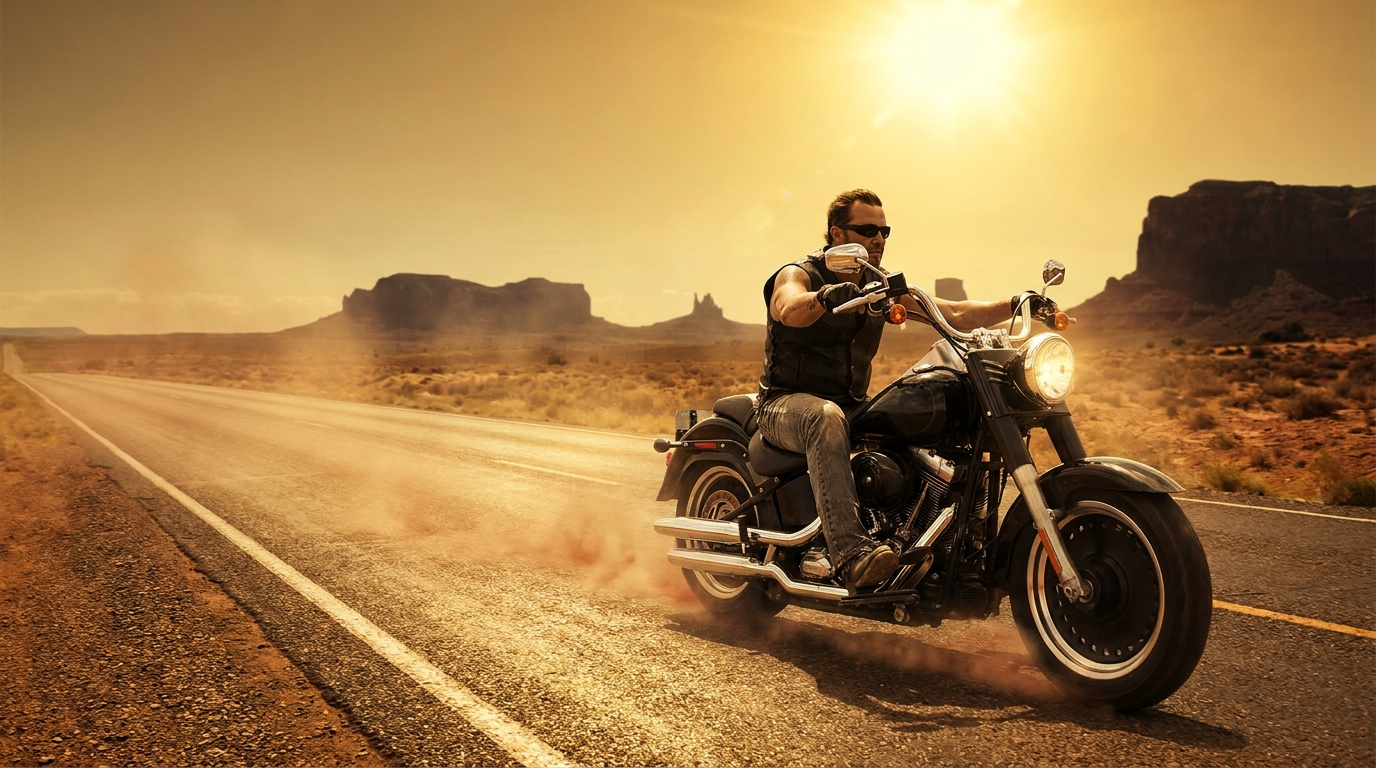
Riding a motorcycle in extreme heat comes down to four things: cover up instead of stripping down, drink 16 to 24 ounces of water every hour you ride, plan your miles for early morning or late evening, and know the warning signs of heat exhaustion before your brain gets too cooked to notice them. It sounds backwards, but once the air temperature climbs past your skin temperature, around 93 degrees F, that glorious highway wind stops cooling you off and starts baking you like a rotisserie chicken. Here is how to ride through the hottest weeks of summer without melting into your seat, told straight, with a little Skull Society attitude.
Why Does Riding in the Heat Feel Hotter Than Standing Still?
Wind cools you by pulling heat off your skin. That only works while the air is cooler than you are. Your skin sits at roughly 93 degrees F, so on a 100 degree day every mile per hour of wind is blowing hot air across your body like a hair dryer on high. Add engine heat rising off the jugs at every stoplight and black asphalt radiating from below, and a rider can be cooking in temperatures well above what the weather app claims.
That is why the shirtless guy blasting down the interstate at 80 mph is not tougher than you. He is dehydrating faster than you, sunburning faster than you, and one tar snake away from losing a lot of skin he was rather attached to.
What Should You Wear Riding a Motorcycle in Hot Weather?
Counterintuitive rule number one: more coverage, not less. Desert riders have known this forever. Loose, light layers keep the sun off and slow down sweat evaporation so it actually cools you instead of flashing off instantly. Here is the hot weather kit that works:
- Mesh armored jacket. Full mesh panels flow air at speed while CE armor at the elbows, shoulders, and back keeps your hide where it belongs. Airflow and crash protection are not either-or.
- Moisture-wicking base layer. A light long-sleeve base layer under mesh beats bare skin under mesh. It spreads sweat out so the wind cools more of you.
- Cooling vest. Soak it, wring it, wear it. Evaporative vests can keep your core comfortable for a couple hours of riding.
- Vented gloves and boots. Sweaty palms on a throttle are a control problem, not just a comfort problem.
- Sunscreen on everything exposed. The biker tan line is a badge of honor until the dermatologist gets involved.
Save the tank top for when the kickstand is down. That is what it is for: bike night, the bar, the campsite at the rally.

2 Wheels Move The Soul (Ladies)
From $23.97, available as a tank top for those kickstand-down moments
Shop the shirtHow Hot Is Too Hot to Ride a Motorcycle?
There is no magic cutoff, but your risk climbs fast with the heat index. Use this as a rough field guide:
| Heat index | What it means for riders |
|---|---|
| Below 85°F | Normal precautions. Hydrate, wear your gear, enjoy the ride. |
| 85 to 95°F | Mesh gear, water every hour, plan shade stops. |
| Above 95°F | Cooling vest territory. Frequent stops, electrolytes, shorter legs between breaks. Consider riding at dawn or dusk instead. |
Above 95, ask yourself the honest question: is this ride for fun or for pride? Fun can wait until 7 pm. Pride is how riders end up on an IV drip in a gas station parking lot.
How Much Water Do You Need on a Hot Ride?
More than you think, and earlier than you think. In 90 to 100 degree conditions, aim for 16 to 24 ounces of water every hour. Once it pushes past 100, you are into a quart or more per hour, and plain water alone stops cutting it. Add electrolytes, because sweating out your salts and replacing them with nothing but water is its own kind of trouble.
Two rules that save rides: drink before you are thirsty, because thirst means you are already behind, and check your fuel stops. If your bladder is not asking for a break by the time your tank is, you are not drinking enough. A hydration pack under the jacket lets you sip at speed without pulling over.

Sometimes It Takes A Whole Tank Of Gas Before I Can Think Straight
From $24.97, printed in the USA. Wear it at the gas stop while you drain a water bottle.
Shop the shirtWhen Should You Ride in the Summer?
Dawn patrol and evening runs. The coolest window is sunrise to about 10 am, and the pavement finally gives its heat back after 6 or 7 pm. Midday is for shade, cold drinks, and letting the bike tick itself cool. If you are crossing real distance in a heat wave, do what long-haul riders do: roll out at first light, knock out your miles before noon, and hole up through the furnace hours.
Watch your bike too. Air-cooled engines idling in stop-and-go traffic on a 100 degree day get mean. If traffic is parked, find a reason to keep moving or shut it down and wait it out in the shade.
What Are the Signs of Heat Exhaustion on a Motorcycle?
Heat does not just make you sweaty, it makes you stupid, and stupid is dangerous at 70 mph. Dehydration and heat exhaustion impair concentration, which is the one thing riding demands. Pull over and cool down if you notice any of these:
- Headache, dizziness, or trouble focusing on traffic
- You have stopped sweating even though it is blazing hot
- Goosebumps or chills in the heat, a serious red flag
- Nausea or muscle cramps
- Irritability or foggy, slow decisions, often easier for your riding buddy to spot than for you
The fix is not toughing it out. It is shade, water, and time. Get off the bike, get the gear open, get fluids in, and do not saddle up until your head clears. Riders look out for each other, so at group stops, actually look at each other.
FAQ: Riding a Motorcycle in Hot Weather
Is it better to ride in a t-shirt when it is hot?
No. Above roughly 93 degrees F, wind on bare skin adds heat and speeds up dehydration, plus you are one slide away from paying skin for pavement. Wear ventilated mesh gear on the road and save the tee or tank for when you park.
How much water should I drink while riding in the heat?
Roughly 16 to 24 ounces per hour when it is 90 to 100 degrees F, more with electrolytes when it climbs past 100. Drink before you feel thirsty.
Does a cooling vest actually work on a motorcycle?
Yes. Evaporative vests hold water and release it slowly as you ride, pulling heat off your core for a couple of hours per soak. They work best under a mesh jacket where air can flow across them.
What time of day is safest to ride in summer?
Early morning and evening. Sunrise to about 10 am is the coolest, safest window, and after 6 pm the pavement starts shedding heat. Avoid the midday furnace when heat indexes peak.
Can extreme heat damage my motorcycle?
Extended idling in extreme heat is hard on engines, especially air-cooled V-twins that depend on moving air. Keep moving when you can, watch for signs of overheating, and give the bike shade breaks along with yourself.
Ride Smart, Look Good Doing It
Summer riding is the whole reason most of us put up with winter. Handle the heat like a pro: gear on the highway, water at every stop, miles before noon. And when the kickstand goes down and the mesh jacket comes off, make sure what is underneath says something worth reading.

Work Sucks, Let's Ride
From $24.97, printed in the USA. The official uniform of the 7 pm heat-dodging ride.
Shop the shirt

Leave a comment
This site is protected by hCaptcha and the hCaptcha Privacy Policy and Terms of Service apply.