
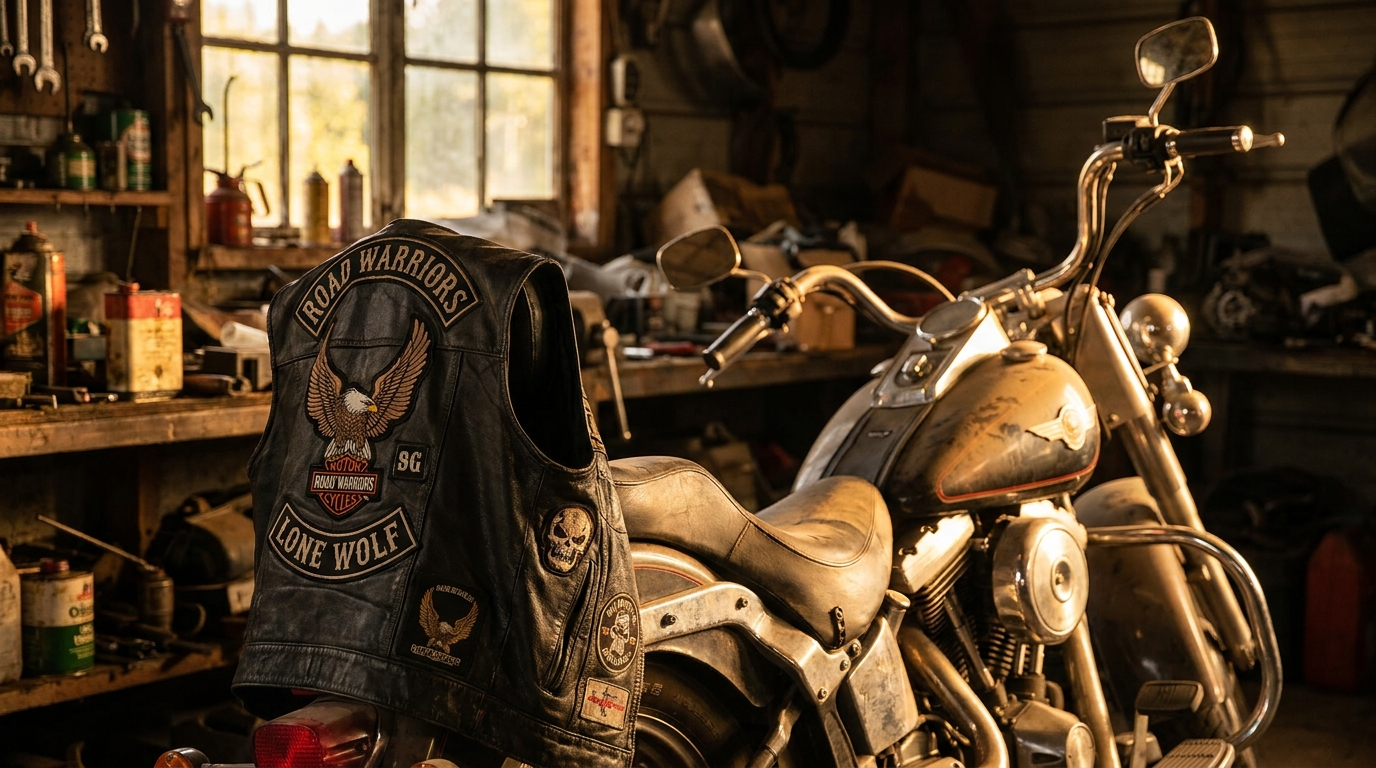
Here is the short answer: biker vest patches are a rider's resume, stitched in thread. A three-piece patch (top rocker, center emblem, bottom rocker) means the wearer belongs to a motorcycle club and earned that membership. A one-piece patch usually means a riding club or a brand. The diamond shaped 1% patch signals an outlaw club. And the first rule of cut etiquette is simple: never touch another rider's vest. Not to admire it, not to move it, not ever. Everything else in biker patch culture flows from that one idea, because a cut is not clothing. It is identity, history, and loyalty worn in public. Here is what the patches mean and how to act around them.
What Is a Biker Cut, Exactly?
A cut (some riders say kutte, or just "colors" when club patches are on it) is a vest, usually leather or denim, that carries a rider's patches. The name comes from the old practice of cutting the sleeves off a denim jacket, a habit that took hold with returning World War II veterans who built the postwar riding scene. Sleeves got in the way, and a cut ran cooler in summer, so the sleeveless jacket became the uniform.
Over decades, the cut turned into a canvas. Club insignia, memorial patches for fallen brothers, rally pins from Sturgis and Daytona, flags, and rank patches all found a home on it. Two riders can read each other's vests in a parking lot and know most of each other's story before a word is spoken. That is the entire point.
What Does a Three-Piece Patch Mean?
The back of a cut tells you what kind of rider you are looking at. The structure matters more than the artwork.
| Patch style | What it usually means |
|---|---|
| Three-piece (top rocker, center emblem, bottom rocker) | A traditional motorcycle club (MC). The top rocker carries the club name, the center is the club emblem, the bottom rocker usually names the territory or chapter. These are earned, never bought. |
| Two-piece | Often a club in transition or a club that deliberately avoids the full MC look. Meaning varies by region. |
| One-piece | A riding club (RC), a veterans group, or a brand. Social, not territorial. |
| 1% diamond | The wearer's club identifies as an outlaw club that operates outside sanctioned riding organizations. |
| MC cube | A small square patch reading "MC," confirming motorcycle club status. |
| Office patches (President, Sgt at Arms, Road Captain) | Front patches showing the wearer's rank and duties inside the club. |
| Memorial patches ("In Memory Of") | Honor a fallen rider. Treated with the most respect of any patch on the vest. |
One more detail worth knowing: a prospect (a member in training) often wears only a bottom rocker until the club votes him in. When a rider gets his full patch, it is one of the biggest days of his life. That is why the etiquette around these things is so serious.
What Does the 1%er Diamond Patch Mean?
The story goes back to the Hollister, California rally over the July 4th weekend of 1947, when sensational press coverage painted motorcyclists as a menace. Legend says the American Motorcyclist Association responded that 99% of riders are law-abiding citizens, and the outlaw clubs happily claimed the remaining one percent. The AMA has long said it has no record of anyone there actually making that statement, but the label stuck anyway. Clubs that reject sanctioned organization rules wear the diamond shaped 1% patch as a badge of that heritage.
If you see a 1%er diamond, the practical advice is easy: be polite, mind your business, and do not play dress-up in anything that imitates their style.
What Are the Unwritten Rules of Cut Etiquette?
These rules are not written down anywhere official, which is exactly why breaking them marks you as an outsider instantly.
- Never touch another rider's cut. Not on their back, not on a chair, not hanging on a sissy bar. A cut is treated as an extension of the person.
- Never wear a three-piece rocker set you did not earn. Buying MC-style rockers online and wearing them to a rally is the fastest way to get a very uncomfortable conversation.
- Do not wear another club's support gear without knowing what it means. Support shirts are fine when you actually support that club. Know what you are putting on.
- Do not interrogate a patch holder about his patches. If he wants you to know, he will tell you.
- Respect memorial patches. Jokes near an "In Memory Of" patch land about as well as jokes at a funeral.
- Keep your hands off a parked bike with colors on it. Same rule, bigger consequences.
Can You Wear Patches Without Joining a Club?
Absolutely. Most riders on the road are independents, and nobody expects you to prospect for two years just to look like you belong on a motorcycle. Rally patches, flag patches, veteran patches, and brand patches are all fair game on a vest, as long as the back of it does not imitate a club's rocker layout.
And honestly, a lot of riders skip the patch politics entirely and let a shirt do the talking. That is kind of our whole thing at Skull Society. Every design is printed in the USA, says exactly what it means, and requires zero votes from a clubhouse. A few favorites from the crew:

Back-print classic with the Skull Society logo on the chest. From $24.97.
Shop this shirt

For the rider whose loyalty list is short and has two wheels at the top. From $23.97.
Shop this shirt

"I've spent a lot of time behind bars." Handlebars, officer. From $23.97.
Shop this shirt

Back-print prayer for the riders who pray up before they mount up. From $23.97.
Shop this shirt
Biker Patch FAQ
Is it illegal to wear a 1%er patch if you are not in a club?
No law stops you, but the clubs who own those symbols enforce them their own way. Trademark law also protects many club emblems. Treat it as a hard no.
What does a bottom rocker by itself mean?
Usually a prospect, a member in training who has not yet earned the full patch. It can also name territory, which is why unaffiliated riders should avoid bottom rockers entirely.
Can women wear cuts and patches?
Of course. Women ride, prospect, and patch into clubs, and plenty of women's riding clubs run their own colors. The same etiquette applies to everyone.
Where should patches go on a vest?
Club insignia goes on the back and stays reserved for clubs. Independents typically run rally patches, flags, and pins on the front panels. There is no patch police for your front panels, so arrange them how you like.
What is the difference between an MC and an RC?
A motorcycle club (MC) is earned membership with prospecting, votes, and obligations. A riding club (RC) is social and open, built around the riding itself. Both love the road; only one requires you to earn your back patch.
Respect the cut, know the rules, and you will get along fine anywhere bikes gather. And if your vest is still a work in progress, start with what goes under it: shop the full Skull Society collection, printed in the USA for riders who say what they mean.

Leave a comment
This site is protected by hCaptcha and the hCaptcha Privacy Policy and Terms of Service apply.