
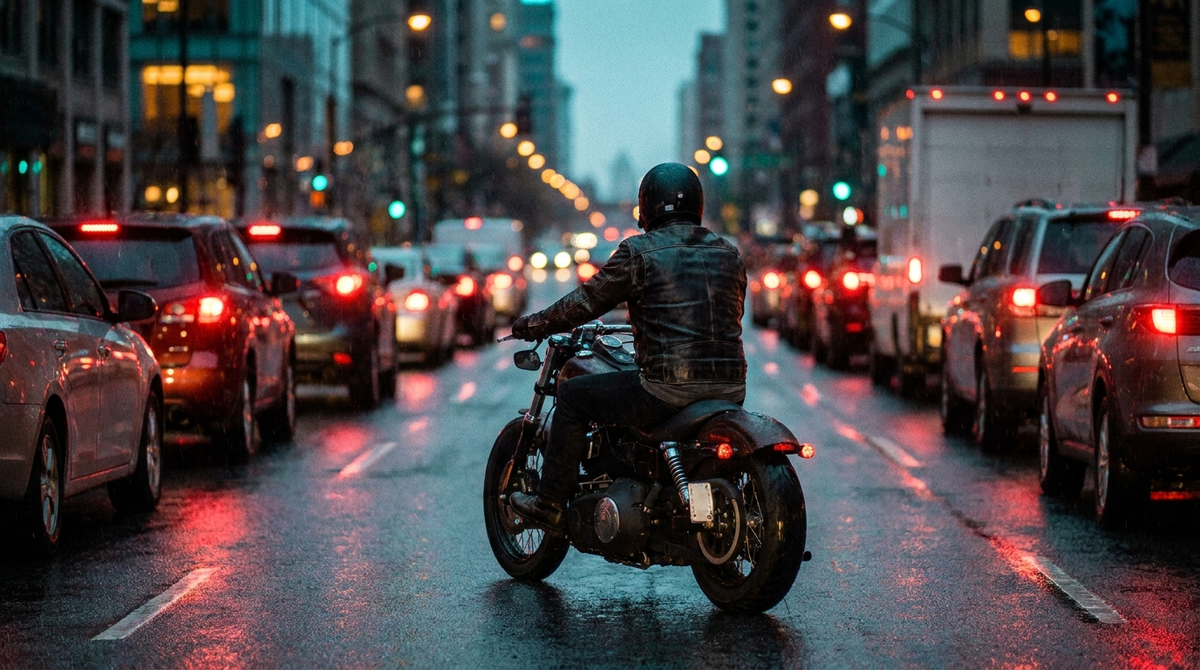
Is lane splitting legal? In most of America, no. As of 2026, California is still the only state where true lane splitting (riding between lanes of moving traffic) is legal. Five more states, Utah, Arizona, Montana, Colorado and Minnesota, allow the calmer version called lane filtering: easing between stopped or crawling cars at low speed, usually at a red light. Everywhere else, riding the dotted line can get you a ticket, and in 35 states it is explicitly banned. Here is the full state-by-state picture, what the safety research actually says, and how to filter without looking like a squid.
In this article
- What is the difference between lane splitting and lane filtering?
- Which states allow lane splitting or filtering in 2026?
- Is lane splitting actually dangerous?
- How do you filter without being that guy?
- What if your state bans it?
- FAQ
What is the difference between lane splitting and lane filtering?
Riders use the terms loosely, but the law does not, and the difference decides whether you ride away or get pulled over.
Lane splitting is riding between two lanes of moving traffic headed the same direction, the classic California freeway move. Lane filtering is slipping between stopped or nearly stopped cars, usually to reach the front of a red light. Filtering is what most states have actually legalized, and every one of them caps how fast you can do it. There is also shoulder surfing, riding the shoulder past stopped traffic, which Hawaii allows in limited form because its lanes are too narrow to filter.
If you only remember one thing: outside California, "legal" almost always means slow filtering past stopped cars, not carving between vehicles at 50 mph.
Which states allow lane splitting or filtering in 2026?
Six states currently allow some version of it. The rules are not interchangeable, so know the numbers before you ride across a state line.
| State | What's legal | The fine print |
|---|---|---|
| California | Full lane splitting (legal since 2016) | CHP guidance: stay within about 10 mph of traffic speed, avoid splitting when traffic is moving faster than 30 mph |
| Utah | Filtering only | Traffic must be stopped, rider max 15 mph, roads posted 45 mph or less |
| Arizona | Filtering only | Same recipe as Utah: stopped traffic, 15 mph max, roads posted 45 mph or less |
| Montana | Filtering, the most generous version | Rider max 20 mph, allowed while traffic is rolling at 10 mph or less |
| Colorado | Filtering only (since August 2024) | Stopped traffic only; the law sunsets in September 2027 unless lawmakers extend it |
| Minnesota | Filtering only (since July 2025) | Rider max 25 mph and no more than 15 mph faster than traffic; drivers are barred from blocking you |
Roughly eight more states, including Texas, Oregon, Washington, Massachusetts and Virginia, have filtering bills kicking around their legislatures, so this map keeps shifting. Laws change and details matter, so before you ride a new state, check its DOT or statute directly. This article is rider-to-rider information, not legal advice.
Is lane splitting actually dangerous?
Less than most cagers think. The best research we have is a 2015 UC Berkeley study that examined nearly 6,000 motorcycle crashes in California. Riders who were splitting when they crashed were notably less likely to be rear-ended, less likely to suffer head or torso injuries, and less likely to die than riders in other crashes. The catch: those numbers held when traffic was moving at 50 mph or less and the rider stayed within about 15 mph of surrounding traffic. Split fast into fast traffic and the advantage disappears.
The logic is simple. Sitting at the back of a stopped queue with a texting driver closing in behind you is one of the most dangerous places a motorcycle can be. Filtering to the front takes you out of the crumple zone and puts you where the cross-traffic can see you. That is why groups like the American Motorcyclist Association support legal filtering. It is not about impatience. It is about not becoming a hood ornament.
How do you filter without being that guy?
Legal or not, filtering done badly is how riders end up starring in dashcam compilations. A few unwritten rules keep it clean:
- Speed differential is everything. Keep it under 10 to 15 mph faster than the cars beside you. If traffic starts rolling, merge back in.
- Use the 1-2 lane seam. Between the far-left lane and the next one over is where drivers most expect a bike, at least where splitting is legal.
- Cover your levers and watch front wheels. A car's front wheel twitching toward the gap tells you about a lane change before its signal ever will.
- Mind the mirrors. Bar-end mirrors and wide bars meet truck mirrors at exactly the wrong height. Know your bike's width cold.
- Don't punish hesitation. No revving at cars, no mirror slaps, no teaching moments. Every angry cager becomes a voter the next time a filtering bill comes up.
- At the light, stage smart. Slot in front of the first car, in gear, eyes on the cross traffic, and launch clean when it goes green.
If half these terms are new to you, brush up with our biker slang decoder, and if you ride with a crew, make sure everyone knows their hand signals before anyone starts filtering in formation.

The honest answer to every driver who honks while you filter past. Printed in the USA on 100% preshrunk cotton.
What if your state bans it?
Then don't do it, simple as that. A splitting ticket in a ban state can mean fines, points, and an insurance adjuster who suddenly decides your crash was your fault. Worse, drivers in ban states genuinely do not expect a bike between lanes, and surprise is the enemy of every rider.
What you can do is make the legal version happen. Filtering laws in Utah, Montana, Colorado and Minnesota all started with riders showing up: joining the AMA's action alerts, writing state reps, and showing lawmakers the Berkeley data instead of the stereotype. Five years ago only three states allowed filtering. Now it is six with bills pending in eight more. That is not luck. That is bikers doing the boring paperwork.
Frequently asked questions
Is lane splitting legal in California in 2026?
Yes. California legalized it in 2016 and remains the only state allowing true lane splitting in moving traffic. CHP safety guidance says to stay within about 10 mph of surrounding traffic and avoid splitting once traffic moves faster than 30 mph.
What states allow lane filtering in 2026?
Utah, Arizona, Montana, Colorado and Minnesota allow low-speed filtering past stopped or slow traffic, each with its own speed caps. California allows full splitting. Hawaii permits limited shoulder use past stopped traffic. Everywhere else, assume it is illegal.
Is lane splitting safer than sitting in traffic?
Done slow, the evidence says yes. UC Berkeley's study of nearly 6,000 California crashes found splitting riders were less likely to be rear-ended and suffered fewer serious injuries, as long as traffic was under about 50 mph and the rider stayed within 15 mph of it. The safety edge vanishes at higher speeds.
Can I filter between a car and the curb?
Almost never. Filtering laws generally cover the space between travel lanes going the same direction. Passing on the shoulder or between a car and the curb stays illegal in most states, with Hawaii's shoulder rule the odd exception.
Do drivers have to let motorcycles filter?
In Minnesota, drivers are specifically prohibited from intentionally blocking a filtering motorcycle. Most other filtering states don't spell it out, which is one more reason to filter slow, stay visible and assume nobody is going to make room for you.
Front of the Pack, Front of the Queue
Skull Society tees are designed and printed in the USA for riders who never sit in traffic quietly.
Shop the collection →Guaranteed safe checkout. If you don't love it, we'll make it right.


Leave a comment
This site is protected by hCaptcha and the hCaptcha Privacy Policy and Terms of Service apply.