
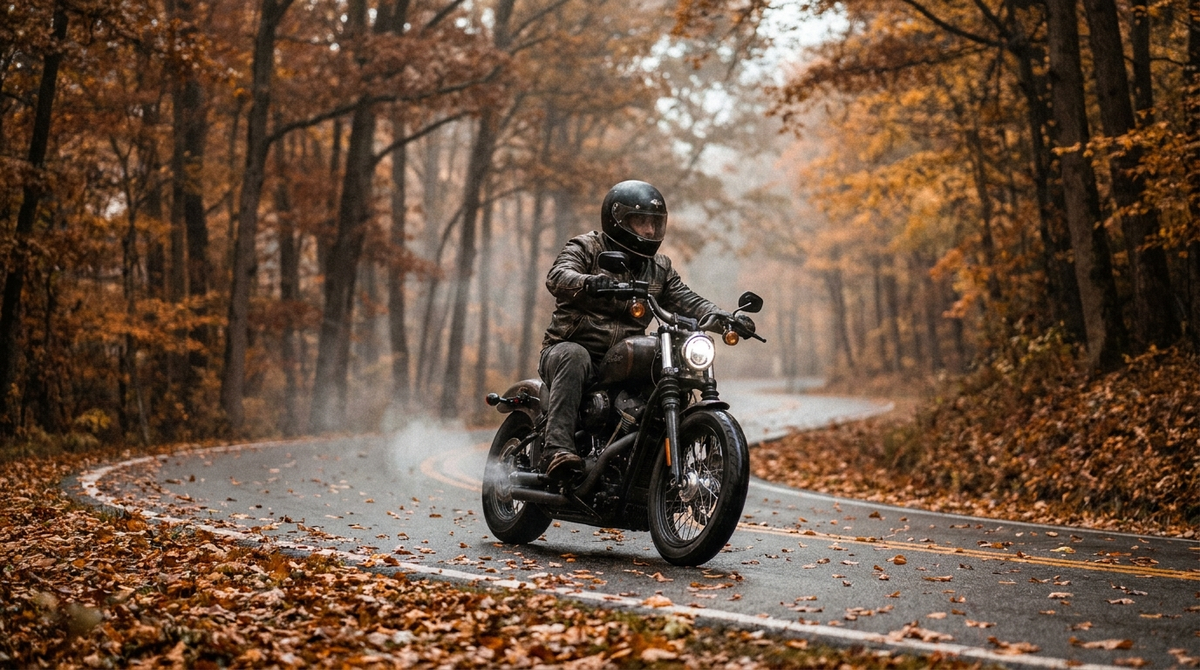
Fall might be the best riding season of the year: empty roads, cool air your engine loves, and scenery that makes every route look like a postcard. It is also the season that punishes autopilot. The four things that put riders down in fall are cold tires that grip like plastic for the first few miles, wet leaves that hide the road surface, deer that get stupid from October through December, and temperature swings that start your day near freezing and end it in the 70s. Every one of them is manageable if you see it coming. Here is how smart bikers keep logging miles until the snow flies.
In this article
- Why is fall riding different from summer riding?
- Tip 1: Give your tires time to wake up
- Tip 2: Treat wet leaves like ice
- Tip 3: Ride like every field has a deer in it
- Tip 4: Layer like a rider, not like a snowman
- Tip 5: Check your pressures weekly
- Tip 6: Respect the shrinking daylight
- Tip 7: Know when the road is lying to you
- FAQ
Why is fall riding different from summer riding?
Everything that made summer riding easy quietly reverses. Warm asphalt becomes cold asphalt, which means less grip everywhere, all day. Long evenings become early sunsets, so more of your riding happens in low light. And the road itself changes: leaves, sand from early frost treatments, and moisture that never fully dries out of shaded corners. None of that should park your bike. Some of the best rides of the year happen in October, and the legendary roads that were packed in July are empty now. You just ride them with a different head on.
Tip 1: Give your tires time to wake up
Motorcycle tires are designed to grip at operating temperature, and on a 40-degree morning they can take several miles of riding to get there. Cold rubber is hard rubber, and hard rubber slides. The first 10 minutes of any fall ride should be smooth and boring: gentle throttle, easy lean angles, no heroics on your favorite corner. Save the fun for mile five, after the carcass has some heat in it. This is doubly true for the first cold snap of the year, when your summer habits are still loaded in muscle memory.
Tip 2: Treat wet leaves like ice
A dry leaf is a nuisance. A wet leaf is a lubricated patch between your contact patch and the asphalt, and a drift of them in a shaded corner is as close to riding on ice as most of us ever want to get. Worse, leaves hide what is under them: gravel, potholes, painted lines, the edge of the pavement. When you see leaves across your line, do your braking early and upright, roll through with neutral throttle, and keep the bike as vertical as the corner allows. Never trail-brake across a leaf patch mid-lean if you can help it.
Tip 3: Ride like every field has a deer in it
Insurance data shows animal strikes spike from October through December, when deer are breeding, moving and paying zero attention to traffic. For a cage that is a bent fender. For a rider it can be a life-flight. Deer are most active at dawn and dusk, which in fall is exactly when many of us commute. Slow down through wooded sections and field edges, scan the ditches and not just the road, and remember the rule every rural rider knows: where there is one deer, there are usually more right behind it. If a strike is unavoidable, brake hard and stay on the brakes. Swerving at speed usually ends worse than the deer does.
Tip 4: Layer like a rider, not like a snowman
The fall problem is not just cold, it is the swing. A September or October day can start at 38 degrees and finish at 72, and wind chill makes the mornings brutal: at highway speed, 40-degree air feels close to freezing on your hands and neck. The answer is layers you can shed at a gas stop. A wicking base layer, an insulating mid layer, and a windproof outer shell beat one giant jacket every time, because the layer trapping the heat is not the layer fighting the wind. Block the wind at your neck and wrists, where cold pours in, and your core stays warm twice as long.

Available in long sleeve and hoodie, printed in the USA on 100% preshrunk cotton. Warm under a jacket, honest at the bar.
Tip 5: Check your pressures weekly
Tire pressure drops roughly 1 psi for every 10-degree fall in temperature, so the tires you set in August are underinflated by the first cold week of October. Low pressure means vague steering, squirmy corners and faster wear on the shoulders, exactly what you do not want on cold pavement. Check pressures cold, once a week, all season. It takes two minutes and it is the cheapest handling upgrade in motorcycling. While you are down there, look at your tread: fall is a bad season to be on the last third of a rear tire.
Tip 6: Respect the shrinking daylight
You lose two to three minutes of daylight every day through fall, which means that same ride home from bike night now ends in the dark. Low sun is its own hazard: it blinds drivers behind you exactly when they are trying not to rear-end a motorcycle at a stoplight. Ride with your high beam on during the day where legal, add reflective elements where you can live with them, and assume drivers see even less of you than usual. The crash data has always said cagers fail to see riders long before they fail to hear them, and dusk is when their eyes are worst.
Tip 7: Know when the road is lying to you
Late fall brings the sneakiest hazard of all: pavement that looks fine and is not. Bridges, overpasses and shaded corners freeze first and thaw last, and a damp patch at 34 degrees can be black ice by the time you reach it at 7 a.m. Frost on car windshields in the morning is your signal to leave later, ride slower, or take the cage without shame. There is no trophy for riding across an icy bridge, and every rider who has been down knows the repair bill beats the hospital bill by a mile. When the calendar and the thermometer finally win, put the battery on a tender and start planning spring.
Quick reference: fall hazards and what to do
| Hazard | Where it lives | The move |
|---|---|---|
| Cold tires | First 5+ miles of every ride | Easy throttle and lean until warm |
| Wet leaves | Shaded and tree-lined corners | Brake early, cross upright, neutral throttle |
| Deer | Dawn and dusk, woods and field edges, Oct to Dec | Slow down, scan ditches, brake hard, don't swerve |
| Temperature swings | Any full day in the saddle | Layers you can shed, wind blocked at neck and wrists |
| Black ice and frost | Bridges and shade below about 37 degrees | Leave later, slow down, or skip the ride |
| Early darkness | Every evening ride after September | Lights on, reflectives, assume you're invisible |
Frequently asked questions
What temperature is too cold to ride a motorcycle?
There is no magic number, but two lines matter. Below about 50 degrees, tires take noticeably longer to warm up and grip less at full temperature, so ride accordingly. Below freezing, or any time frost or ice is possible on the road, the risk stops being about comfort and starts being about traction you cannot get back. Wind chill matters too: 40-degree air at highway speed feels close to freezing on exposed skin.
Are wet leaves really as slippery as ice?
Close enough that the difference will not comfort you. A layer of wet leaves drastically cuts the friction between tire and road, and it also hides whatever is underneath. Treat any leaf-covered patch the way you would treat a painted line in the rain: upright, steady, no sudden inputs.
When are deer most dangerous to motorcycle riders?
October through December, during breeding season, and especially in the hour around dawn and dusk. That is when deer movement peaks and light is worst. Wooded roads and field edges are the highest-risk stretches, and deer rarely travel alone.
Do I need heated gear for fall riding?
For most fall riding, no. Smart layering with a windproof outer shell handles mornings down into the 40s for typical ride lengths. Heated grips or gloves become worth it if you regularly ride more than an hour in temperatures below about 45 degrees, because cold hands are slow hands on the controls.
How does cold weather affect tire pressure?
Expect to lose roughly 1 psi for every 10-degree drop in air temperature. A bike set perfectly in 90-degree August heat can be 4 to 5 psi low on a 40-degree morning, enough to change how the bike steers and wears. Check pressures cold, weekly, through the whole season.
The season isn't over. Dress like it.
Long sleeves and hoodies printed in the USA, built for cold-morning miles and the diner stop after.
Shop Skull Society →100% designed and printed in the USA. Safe and secure checkout.
Rode through the other extreme this year? Here's our guide to riding in extreme heat, and if you're carrying a passenger on those fall color runs, read how to ride two-up the right way.

Leave a comment
This site is protected by hCaptcha and the hCaptcha Privacy Policy and Terms of Service apply.